
How to Build a Small‑to‑Medium Livestock Biobank: A Complete Practical Guide

Building a small‑to‑medium livestock biobank is the most cost‑effective way for commercial breeding farms, artificial insemination centers, and regional livestock enterprises to preserve premium animal genetic resources. If you want to stably store frozen semen, embryos, and critical breeding samples for long‑term genetic improvement, you need a standardized, compact, and fully functional biobank setup. This guide explains how to build a small‑to‑medium livestock biobank with practical steps, essential equipment, standardized workflows, and risk control solutions tailored for commercial breeding scenarios.
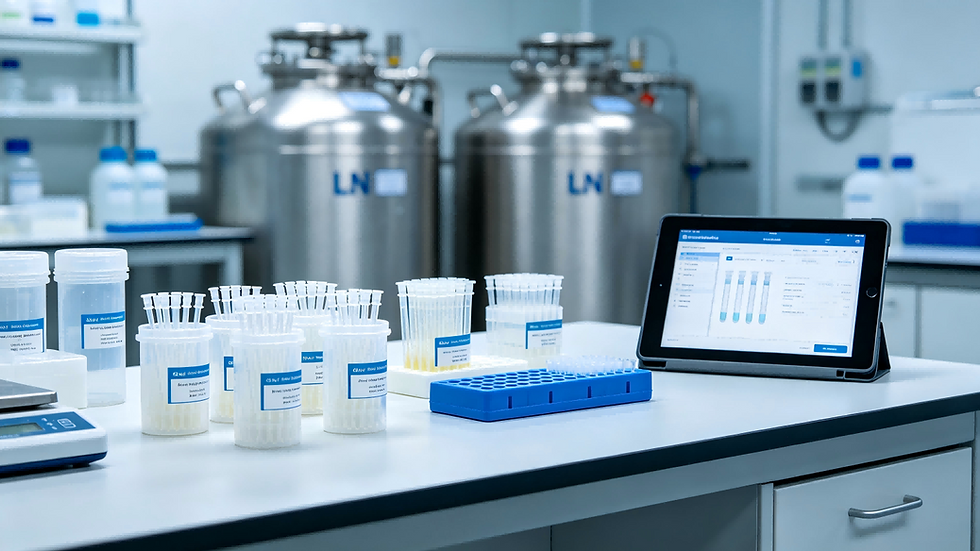
1. Define Clear Goals for Your Small‑to‑Medium Livestock Biobank
Unlike large national genetic resource biobanks or university research‑focused biobanks, a commercial small‑to‑medium livestock biobank focuses on practical breeding production and long‑term genetic preservation. Before construction, clarify your core positioning to avoid over‑investment or insufficient configuration.
Core positioning of commercial livestock biobanks:
Main sample types: Frozen semen straws (0.25ml / 0.5ml), primary livestock embryos, and routine breeding tissue samples
Service scenarios: Daily breeding production, elite breed resource retention, seed stock renewal, and commercial AI service support
Storage cycle: Long‑term stable preservation (10–20 years) with regular sample retrieval and replacement
Scale orientation: Suitable for 500–5000 breeding sample storage capacity, matching the operation scale of most private breeding farms and regional insemination centers
2. Site & Safety Configuration for Small Livestock Biobanks
A professional livestock biobank does not require oversized space, but it must meet cryogenic safety and laboratory operating standards. Reasonable site layout is the foundation of stable long‑term operation.
Key site requirements:
Independent partition layout: Separate sample reception & processing area, cryogenic storage area, and data management area to avoid cross‑contamination and operational confusion
Cryogenic safety protection: Equip the LN₂ storage room with oxygen concentration alarms and professional ventilation systems to prevent hypoxia risks caused by liquid nitrogen volatilization
Stable power supply: Configure a UPS uninterruptible power supply to avoid equipment shutdown and sample damage due to sudden power failure
Load & fire protection: Reinforce ground bearing capacity for LN₂ tanks and equip basic fireproof and explosion‑proof facilities
3. Essential Equipment List for How to Build a Small‑to‑Medium Livestock Biobank
Complete and compatible equipment determines sample survival rate and biobank operational efficiency. A standard small‑scale livestock biobank covers three core modules: sample processing, cryogenic storage, and intelligent management.
3.1 Frozen Semen & Sample Processing Equipment
All samples must be professionally processed before storage to ensure activity and traceability:
Semen collection and detection devices (microscopes, semen analyzers) for quality screening
Automatic filling and sealing machines for standardized straw packaging
Straw label printers for unique sample coding and batch marking
Programmable freezing systems for gradient cooling to protect sample activity
Centrifuges and autoclaves for laboratory pretreatment and sterilization
3.2 Core LN₂ Cryogenic Storage System
Long‑term preservation of livestock frozen samples relies entirely on stable ‑196°C liquid nitrogen storage. For small‑to‑medium biobanks, portable and vertical LN₂ tanks with low evaporation loss are the most cost‑effective choice:
Medium‑capacity LN₂ storage tanks with narrow‑neck design, reducing evaporation loss by 15‑25% to cut daily operating costs
Dry shippers for safe long‑distance transportation of incoming and outgoing samples
Tank roller bases and protective accessories for convenient movement and daily maintenance
3.3 Intelligent Monitoring & Consumables
Smart monitoring caps for real‑time tracking of LN₂ temperature and liquid level
Professional cryogenic protective gloves and aprons for operator safety
Compatible 0.25ml / 0.5ml semen straws, canisters, and racks for classified sample storage
4. Standard SOP Workflow for Daily Biobank Operation
Hardware equipment ensures basic storage conditions, while standardized SOP ensures long‑term orderly operation of the small‑to‑medium livestock biobank and avoids sample confusion or loss.
Complete workflow steps:
Sample Reception & Inspection: Verify animal breed, collection time, and sample quality; eliminate unqualified samples
Professional Processing & Marking: Complete dilution, filling, sealing, and unique code printing to establish sample identity
Programmed Freezing: Adopt gradient cooling procedures to maximize sample survival rate
Classification Warehousing: Store samples in classified racks and record accurate physical positions
Data Archiving: Upload all sample information to the management system to realize one‑to‑one data correspondence
Daily Maintenance: Regularly check LN₂ liquid level, temperature data, and equipment status
Standard Outbound Management: Implement approval and recording procedures for sample retrieval and transportation
5. Core Risk Control for Small Livestock Biobanks
Most small‑scale biobank failures come from neglected details rather than insufficient equipment. Focus on these three key risks:
5.1 Avoid Sample Traceability Failure
Manual labeling and fuzzy printing easily cause batch mixing. Professional straw printers provide durable, frozen‑resistant codes to ensure lifelong traceability of genetic samples.
5.2 Reduce LN₂ Waste & Supply Risks
Ordinary tanks have high evaporation rates, leading to high operating costs. Narrow‑neck high‑efficiency LN₂ tanks effectively reduce consumption, while real‑time monitoring caps prevent liquid nitrogen shortage accidents.
5.3 Prevent Safety Accidents
Closed storage areas lack ventilation, causing hidden hypoxia dangers. Equipping oxygen alarms and special protective gear ensures operator safety.
6. Why Small‑to‑Medium Breeding Centers Need an Independent Biobank
Many commercial breeding institutions rely on third‑party public biobanks for sample storage, which brings uncontrollable risks such as delayed scheduling, sample mixing, and unclear ownership. Building your own small‑to‑medium livestock biobank enables independent control of elite genetic resources, flexible support for daily breeding and AI business, and continuously accumulating high‑value germplasm resources for long‑term farm development.
Build Your Standard Livestock Biobank with Heyi Biotech
If you are planning to build or upgrade a small‑to‑medium livestock biobank, Heyi Biotech provides one‑stop biobank construction solutions. We support a full-set configuration, from sample processing equipment, intelligent coding systems, and high‑efficiency LN₂ storage tanks to safety accessories and consumables, helping you build a standardized, low‑cost, and fully traceable commercial breeding biobank.
Contact us for customized biobank layout plans and equipment configuration suggestions.
Email: heyilabs@gmail.com WhatsApp: +86‑15236623992 Website: www.heyilabs.com


Comments